 They split the current of two strings into a series configuration The idea was to reduce the voltage so the
bulbs would last much longer. The downside is the bulbs are much dimmer, around 10%.
They split the current of two strings into a series configuration The idea was to reduce the voltage so the
bulbs would last much longer. The downside is the bulbs are much dimmer, around 10%.
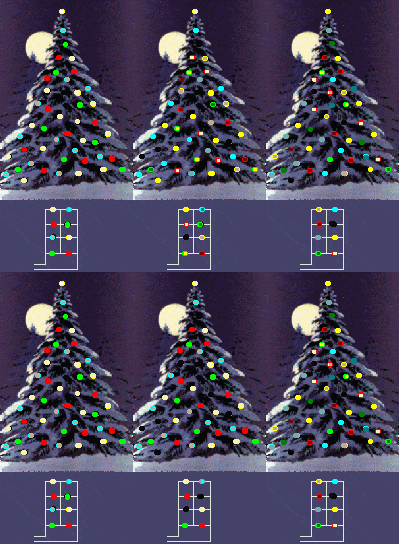
The anamated GIF image on the right shows the variable brightness effect you can get with regular incandescent series string mini Christmas lights plugged into a specially wired pair of extension cord outlets, the outlets wired in series. You can add more sets to the eight shown, and you can get even more variety of brightness levels. Just be sure the amount of strings are equal on both outlets. You may need to swap a few strings from one side to the other and others the opposite way to get a more even distribution of brightness. All the bulbs will run at reduced brightness than normal, but this will dramatically increase bulb life, and will still be plenty bright enough. The time sequence will be completely random in a real setup.
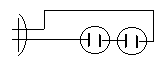
And during the off season, you can use this set of plugs to test old radios using the current limited lightbulb setup. Radio plugs into one of the sockets, a table lamp with a 100W incandescent lightbulb in the other. If the radio has a serious overcurrent problem (like a short), the bulb will light up brightly. This can save blowing a power transformer. I've used this setup to test a power transformer for internal shorted turns. Have no load on the transformer under test. If the bulblights brightly, the transformer probably has internal shorted turns and thus not fit for use.
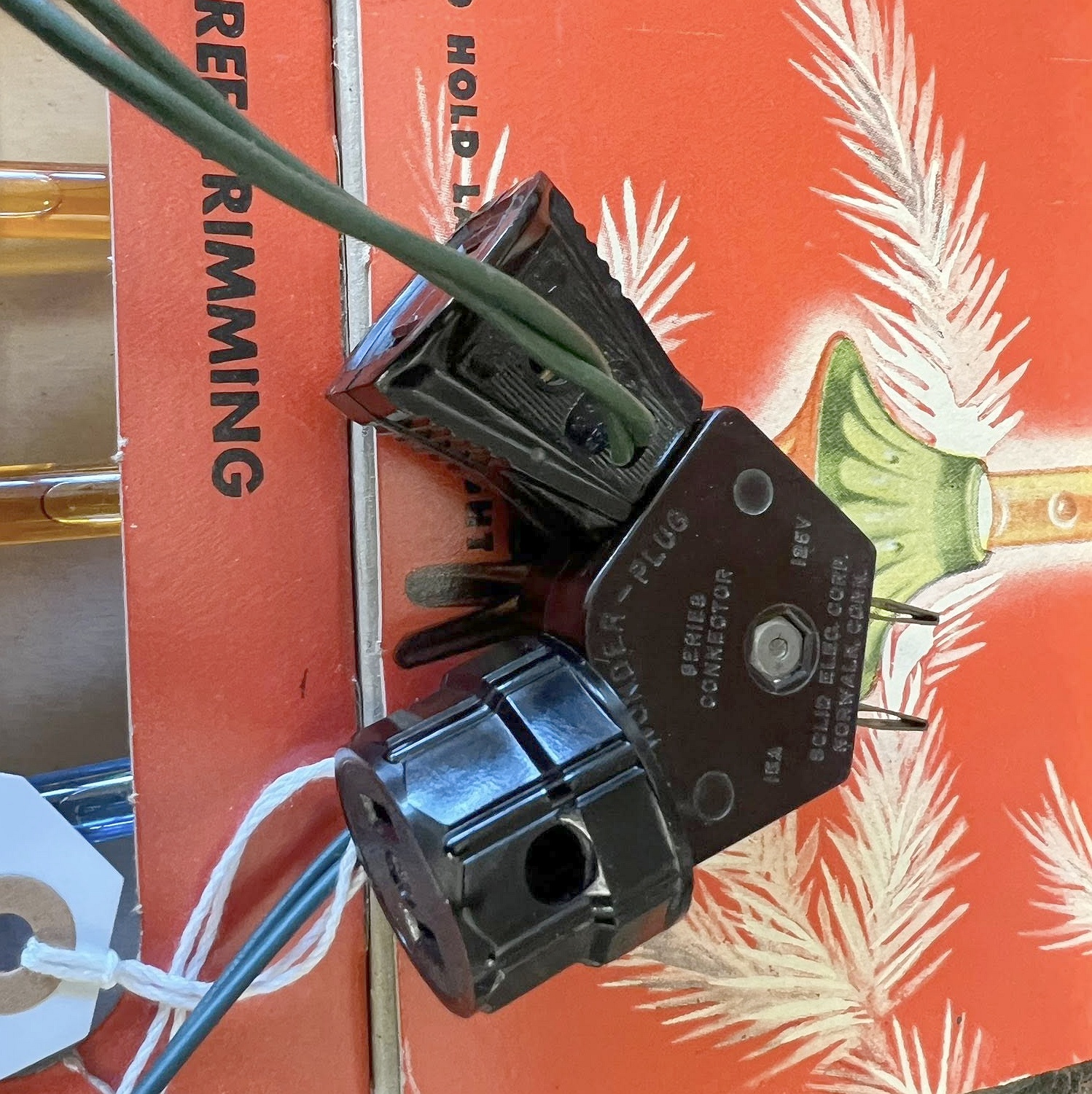
A commercial product that would do the above. "Wonder-plug", "Series connector" by "Solid Elect Corp". Norwalk, Conn.
They split the current of two strings into a series configuration The idea was to reduce the voltage so the
bulbs would last much longer. The downside is the bulbs are much dimmer, around 10%.
| Life extension and power consumption reduction in c6 series string Christmas light sets |


Oh, you could rig up an outlet with a higher amperage diode like an 1N5404 to power multiple unmodified strings, but be sure you or anyone else NEVER uses this outlet to run a load like an AC motor or equipment using a 50 or 60Hz power transformer (you'd burn these out if you did!).
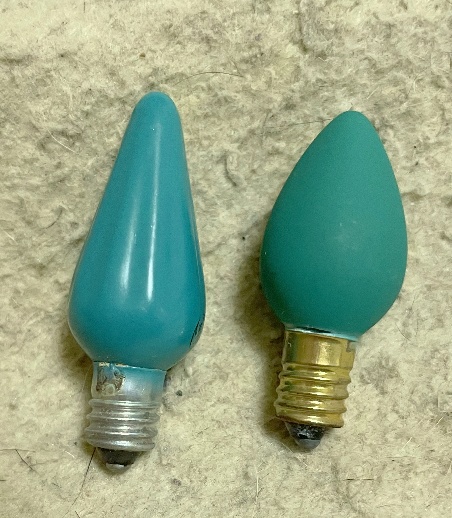
The old versions of c6 bulbs at 15V apiece draw about 300ma. Each of these burns about 4.8 watts. That is the current 8 bulbs in series draw off 120VAC. Some newer c6's draw less, even though still incandescent, about 200ma. Each of these burns about 3 watts. You MUST NOT mix these with old style c6's in a series string, even though they both have the same screw base. All bulbs in a series string must be rated to draw the same current. Or else the bulbs with the lower current rating will see higher than rated voltage across them, causing them to burn out.
One way to test a string of unknown c6 bulbs: connect the string to a dimmer or variac, with the dimmer or variac set to zero voltage, and turn it up slowly. If one or more bulbs seem excessively bright or dim compared to others in the string, you have a bad mix. With the dimmer or variac set to zero, swap the bright or dim bulbs with others and repeat this test until all the bulbs in the string are equally bright. If you see the wattage specified, you can use this to tell these differing c6 bulbs apart.
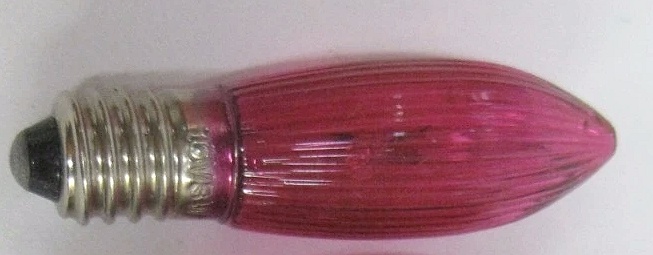
Below are examples of c6 bulbs, on the left you can barely make out a stampling "15V 3W" on its screw shell.
Which would draw 200ma.
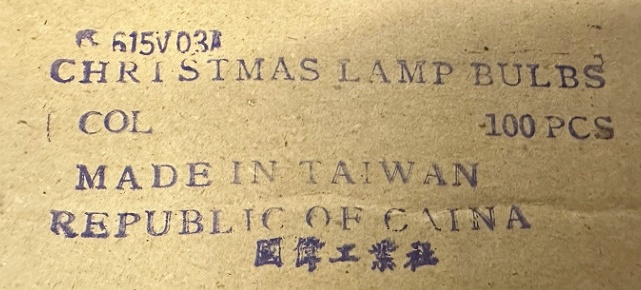
On the right is a box
of c6's somewhat unclearly specified as 15V 0.3A which implies that my above 300ma current measurement was accurate.
| Incandescent tungsten light bulb life extension and brightness change calculation equations |
In the case of the above c6 Xmas light candelabra with the diode, it's the same as 85V instead of 120V across the string. The diode makes the bulbs run approx half power. As power is V2/R, and half the power would require the voltage (without the diode) be √(0.5)=0.707V and that times 120V gets us 85V. So that would be (120/85)13 = 90. Roughly, as the quality of the materials in the fiaments will have an impact. Don't know how accurate these extended life values really are, but they'd surely be in those orders of magnitude.
As for the change in brightness, this equation:
(Actual luminous intensity / Luminous intensity at rated voltage) = (applied voltage / rated voltage)3.45
should be close.
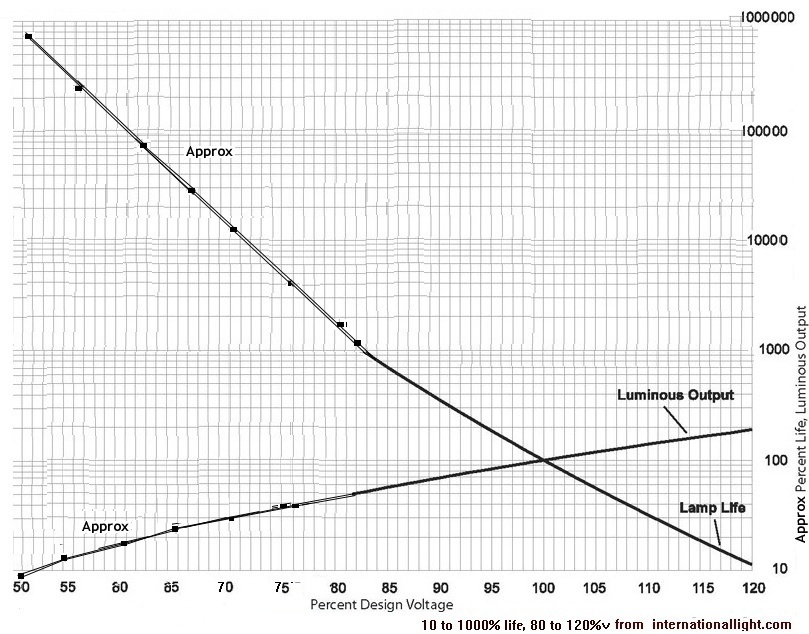
As before, this equation, using voltage percentages shown on the ORIGINAL
range (lower right area
pirated off internationallight.com) of the below graph (80% to 120% rated voltage)
match fairly close to the above equation. I extrapolated down to 50% using this equation. The c6's on 8V
vs the rated 15V would be about 11% as bright, maybe a little too dim (depending on the environment).
The c6 string with the diode would be around
30% rated brightness, still bright enough. And 12 c6's in a string will yield about 25% the brightness of an 8 string (both
without diodes). 11 bulbs
in the string would give you 33% brightness. So a lamp operated at low voltage could last much longer than at rated
voltage, albeit with greatly reduced light output. Efficiency drops dramatically, but that's not much of
an issue with c6 or other Xmas lights. We want them to last.
The filaments would be less fragile too.
| Run LED Xmas strings off Power Over Ethernet |

According to the POE standard, the Ethernet plug pins 4 and 5 have positive 50V, and the return is on pins 7 and 8. (Other systems may put the 50V on twisted pairs 1 and 2, and the return on pair 3 and 6. Check for that if your LEDs won't light up). However, there exists many variations on this, and the polarity can be backwards. We use a bridge rectifier to fix that. On some systems, the pairs on pins 4 and 5, and 7 and 8 may be carrying signals, so we don't want to add any significant additional loading on the twisted pair. The signal impedance of an ethernet twisted pair is 100 ohms. We want to current limit the current thru the LEDs by using series resistance, here 4.7K. You can select some other value for different LED brightness, use that value for all the resistors in the following description. But with 4.7K: We can create this resistance by using one pair of 4.7K resistors to tap the twisted pair on pins 4 and 5 (this will look like a load of 9.4K on the 100 ohm twisted pair, which the signals will not notice) and another pair of 4.7K resistors on the twisted pair on pins 7 and 8. In respect to the POE DC voltage, each resistor pair will look like 2.35K resistance. And the other pair on the other twisted pair is also 2.35K, and both these add up to the desired 4.7K resistnce to current limit the LED string. To avoid trouble with reverse polarity of the POE voltage, we will insert a bridge rectifier between the resistors and the LED string. The diagram shows this.
You can tap onto the wires in an ethernet cable, and heat shrink or tape the connections, resistors and bridge, ot use a pair of RJ45 female connectors to wire the connections and these parts. And use a second ethernet cable to connect to the load.
Now you can decorate the server farm!.
| Using American C7 Xmas light strings in 240VAC countries. Series parallel connection. |

This idea also would work if you have all C9 light strings.
If the bulbs of one string seem brighter than those of another string, try swapping a bulb from the dim string with one in the bright string. Idea is to get the brightness of the two strings in question more equal. One brand's bulbs may draw more current than bulba of another brand. You can even this out by, say, using 3 bulbs of brand A in each of the 3 strings, and 5 bulbs of brand B in each of the 3 strings. This example is shown in the above diagram.